




My buddy JMo (Jay-Moe) is an astute observer of the human condition but it wasn’t always that way. You see, for the better part of the twenty-first century, as a result of a snowboarding accident, JMo has spent most of his hours in a series of wheelchairs; each new one equipped with growing sophistication. Today, without the use of arms or legs, he toggles a chin drive that propels him through his days while assistive technology allows him to use an iPhone, including phoning, texting, navigating, and speaking with Siri. Since much of that technology has only been around for a brief time, JMo often quips, “If I were destined to break my neck, I definitely picked a good time to do it.”
I met JMo years before his accident while he was still in high school and I now spend hours with him every month. Knowing him as I do, I think it safe to say that the course of his life was altered that snowy day in ways well beyond the devastation to his physical self.*
It is as if being freed from the burden of attending to his physical needs—although he is an expert in assisting others how to assist him—his mind has had hours on end to watch and consider the behaviors of others. So deep is his attention to his surroundings that, if he spent an afternoon with several other people who were asked later to give an accounting of what had occurred and what had been said, the most reliable telling would most certainly come from JMo. It is not just a matter of recollection, either. It’s as if that damned chair has freed his mind to ponder the world in a manner that most physically-able people are unlikely to do; a gift for patient observation, deep introspection, and amazingly unique reflections on people and the world we occupy.
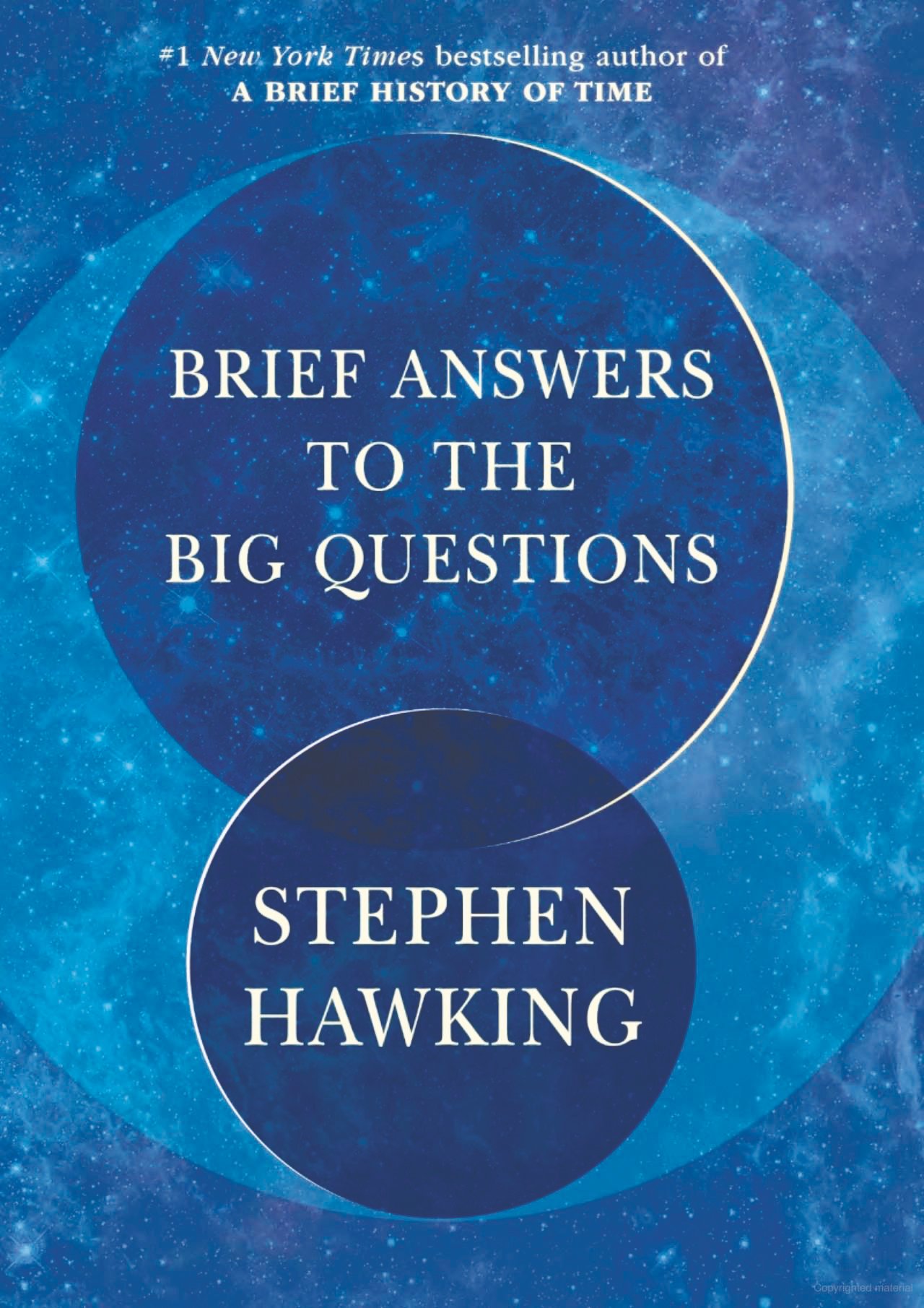
I think of all this now after reading Brief Answers to Big Questions (2018) by globally renowned scientist, theoretical astrophysicist, cosmologist, mathematician, and thinker, Stephen Hawking. Diagnosed with ALS in 1963 at the age of 21, he was confined to a wheelchair by the end of that decade until his death in 2018.
While JMo was not a brilliant scientist before his accident, Stephen Hawking was. So, by comparing the two, I suppose I am suggesting here that Stephen Hawking’s brilliance did not simply shine through his physical deterioration but that much of that brilliance had evolved throughout his life in part because he was confined to that damned chair.
Whether or not you buy that one, it is clear that, much like JMo, Hawking’s failing body invigorated his cerebral self. If you consider JMo’s accident and Hawking’s diagnosis as a sentence of sorts—a fate which befalls many millions —it is only those few who actively decide what they shall do with that sentence; not only to get the most out of life, but to consider seriously what strange advantage may derive from it.
“Before I got motor neuron disease I was bored with life, but the prospect of an early death made me realize life was really worth living,” Hawking said in a 1992 BBC interview.
There is courage in that statement that mirrors what I have seen in my friend. And all that is my way of suggesting that when Stephen Hawking offers up answers to “Big Questions,” we should all take heed. For instance, in an effort to inform what science has to say about questions that have plagued humankind for hundreds of thousands of years, Hawking wastes no time addressing the G-word. While assuring readers that he has no interest in offending those of faith, he pretty clearly answers the question, at least for himself, by pointing out that we are all made of “stardust” and to that dust we shall return.
It is not surprising that, as a man of science, Hawking writes that “[s]cience is increasingly answering questions that used to be the province of religion.” When we think of ancient civilizations and the gods they created to explain the mysteries that surrounded them—lightning, lights in the sky, tides, and so on—his supposition is hard to refute. “Nowadays,” he adds bluntly, “science provides better and more consistent answers, but people will always cling to religion, because it gives comfort, and they do not trust or understand science.”
He does, however, square his commentary about the existence of God by adding what many people of faith have more recently concluded in the face of overwhelming scientific evidence explaining the mysteries of the world. “One could define God,” Hawking poses, “as the embodiment of the laws of nature.”
Other questions seem to carry a little less politically correct baggage such as is there other intelligent life in the universe? As to the evolution of human-style intelligence elsewhere, Hawking suggests that: “It is more likely that evolution is a random process, with intelligence as only one of a large number of possible outcomes.”
He hypothesizes that the development of human intelligence on Earth was dependent on several factors. For example, sixty-six million years ago, an asteroid or comet crashed into Earth killing the dinosaurs. Since these collisions with planets are inevitable, he offers that since we have gone so long without another such collision, it is perhaps just a matter of luck that allowed the time necessary for human intelligence to evolve.
“Other planets in the galaxy on which life has developed,” he considers, “may not have had a long enough collision-free period to evolve intelligent beings.” This is the kind of fascinating insight found throughout Hawking’s thought-provoking book.
Hawking also gets pretty technical by asking What is inside a black hole? “A black hole,” he explains, “is a region where gravity is so strong that light cannot escape.” Hmmm?
Is time travel possible? Hawking shares a great deal of “space-time” talk popularized by Albert Einstein. He then seems to come at this one cross-wise by asking “if time travel will be possible in the future, why hasn’t someone come back from the future to tell us how to do it?” As any good scientist will do, Hawking conducted an experiment on the possibility of time travel by sending out invitations to a party in which only time travellers were invited. “To ensure that only genuine time travellers came,” Hawking jokes in all seriousness, “I didn’t send out the invitations until after the party.”
And if time travel is indeed possible, the corollary question is Can we predict the future? The answer here may not be as rewarding as you might expect but be reminded that the most important thing is the query. This highlights the repeated point that Hawking made throughout his life; science is not the answers we come up with, but rather, science is founded upon the questions we ask ourselves.
In a more practical conclusion to this sometimes mind-blowing book, Hawking asks Will we survive on earth? He reminds us that “the Earth is becoming too small for us. Our physical resources are being drained at an alarming rate. We have presented our planet with the disastrous gift of climate change. Rising temperatures, reduction of the polar ice cap, deforestation, over-population, disease, war, famine, lack of water and decimation of animal species; these are all solvable but so far have not been solved.”
As to the likelihood of another interstellar collision which might threaten humanity, Hawking writes gloomily, “The last big such collision with [Earth] was about sixty-six million years ago… and it will happen again. This is not science fiction; it is guaranteed by the laws of physics and probability.”
Sometimes science can ruin your day.
*Check out my TNT Storyland series “Wednesdays with JMo.”
Big Questions