


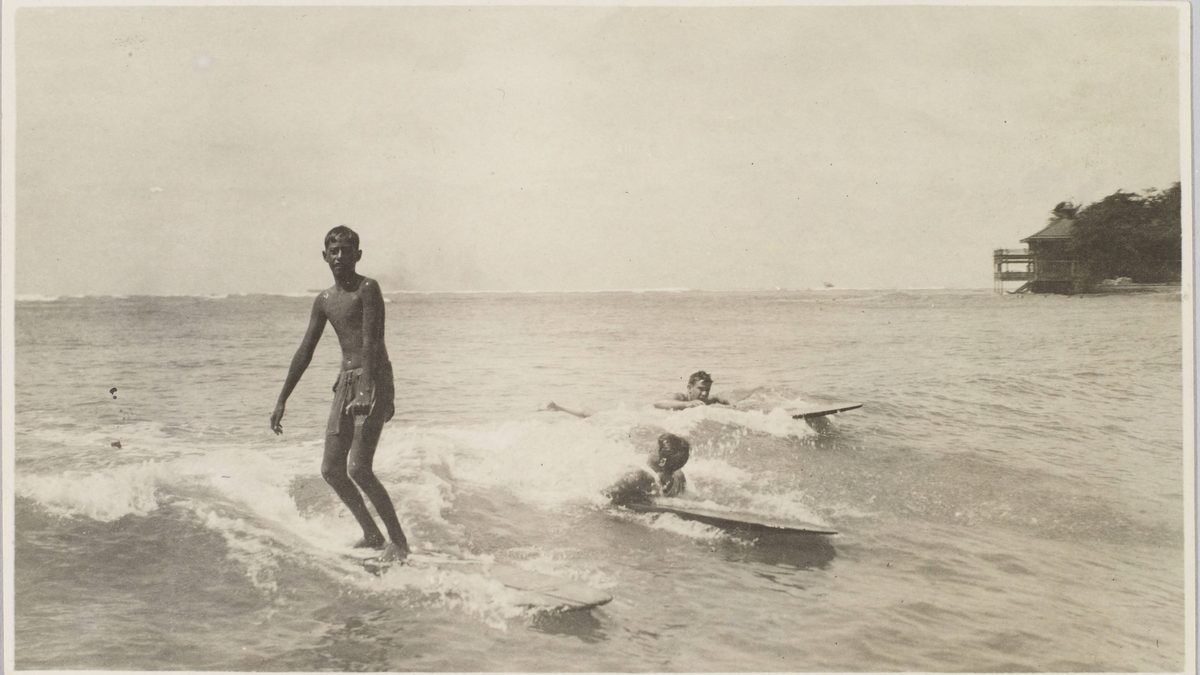


Not far from the chaotic crowds at Waikiki Beach on O‘ahu in Hawaii is a small, plain grave stone in the Freeth family plot. It reads: G.D. 1883-1919. This is the grave of George Douglas Freeth Jr., the man who invented modern ocean lifeguarding and revived the mostly lost art of stand-up surfboarding. George shares his grave with his brother Alexander, who died in childhood. There are no flashy monuments, or tributes of flowers left by an adoring public, but this was a man who changed the world.
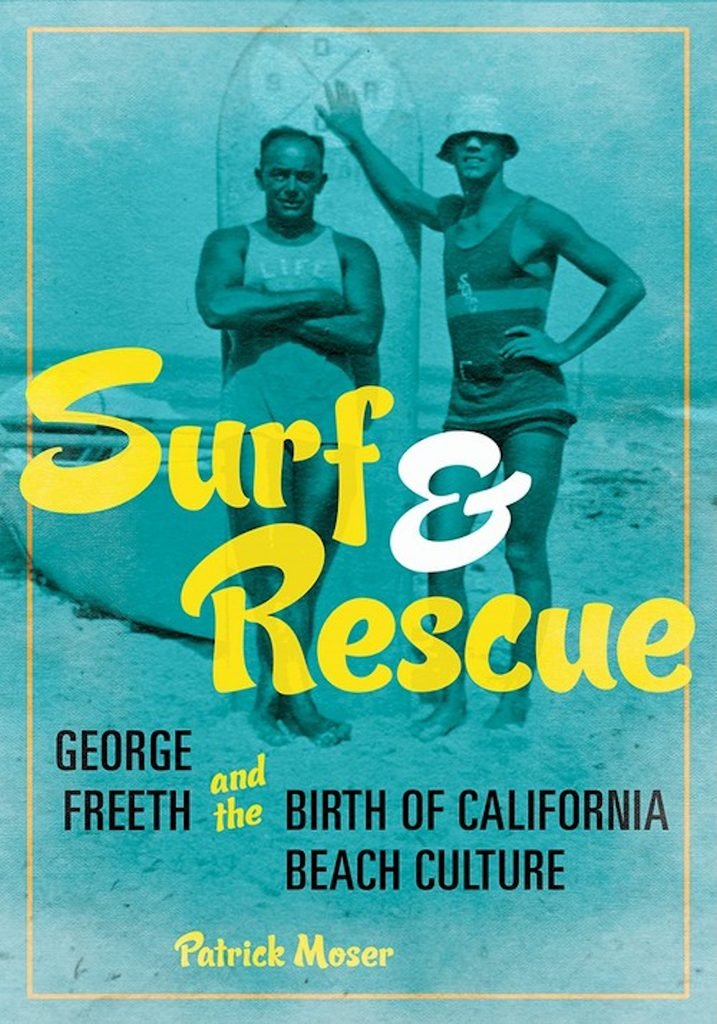
George Freeth taught himself to surf, brought surfing from Hawaii to California, and while he was here, pioneered ocean rescue and lifesaving techniques that still save lives today. He won the Congressional Medal of Honor for singlehandedly saving seven fishermen during a deadly squall off the local coast, but those men were only a few of the many people whom he rescued or who were rescued by the lifeguards he trained. He did all of that in the space of just a few years. George Freeth was only 36 when he died during the great influenza epidemic of 1919.
Freeth wasn’t the first surfer to arrive in California from Hawai‘i. That distinction goes to three young members of the Hawaiian royal family—Prince David Kawānanakoa, Prince Jonah Kūhiō Kalanianaʻole, and Prince Edward Abnel Keliʻiahonui—who were sent to school in San Mateo in the 1890s, and demonstrated surfing for an admiring audience in 1885. The July 20, 1885 Santa Cruz Daily proclaimed, “The young Hawaiian Princes were in the water enjoying it hugely and giving interesting exhibitions of surf board swimming as practiced in their native land.”
The princes’ surfing exhibition seems to have been a local sensation, but surfing didn’t really catch on until after George Freeth’s arrival in California the summer of 1907.
Freeth’s father was an English military officer turned entrepreneur. His mother was from a family that combined English and native Hawaiian heritage. The family lived in Honolulu, where Freeth grew up swimming and diving at Waikiki beach, but he also spent time at remote Laysan Atoll with his siblings, where his father ran a guano mining business. The remote location offered little for the Freeth children to do other than swim.
George grew into a restless young man. In 1898, when he was 15, he traveled to San Francisco, where he began competing in diving and swimming events at the Sutro Baths, a Bay Area bath house that featured huge saltwater pools.
Freeth’s biographer Patrick Moser, author of Surf and Rescue, George Freeth and the Birth of California Beach Culture, theorizes that the four “life savers” who worked at the Sutro baths may have been the young athlete’s first introduction to lifeguarding.
Freeth returned to Hawai’i the following year, but he doesn’t appear to have stayed long. He spent a year in college, and excelled at sports of all kinds, including football and high diving, but was soon on his way back to San Francisco, and from there to the East Coast, where one of his brothers now lived. It wasn’t until he returned home to Hawaii that he developed an interest in the ancient art of surfing.
Surfing was still part of Hawai’ian tradition when Freeth began to teach himself, but it was perilously close to extinction. Political turmoil, and the death of two-thirds of the native Hawaiian population from diseases brought to the Islands by the wave of colonial invaders resulted in the loss of many ancient cultural heritage and traditions.
The Anglo missionaries who arrived in the early nineteenth century were vehemently opposed to the sport.
Various Western visitors, including American author Mark Twain who was there in 1866, and British traveler Isabella Bird, who visited in 1773, described seeing people surf. Twain even gave it a try, but by the end of the nineteenth century, most of the remaining surfboards were bellyboards, or paipo, that were ridden prone. The art of riding standing up had almost disappeared.
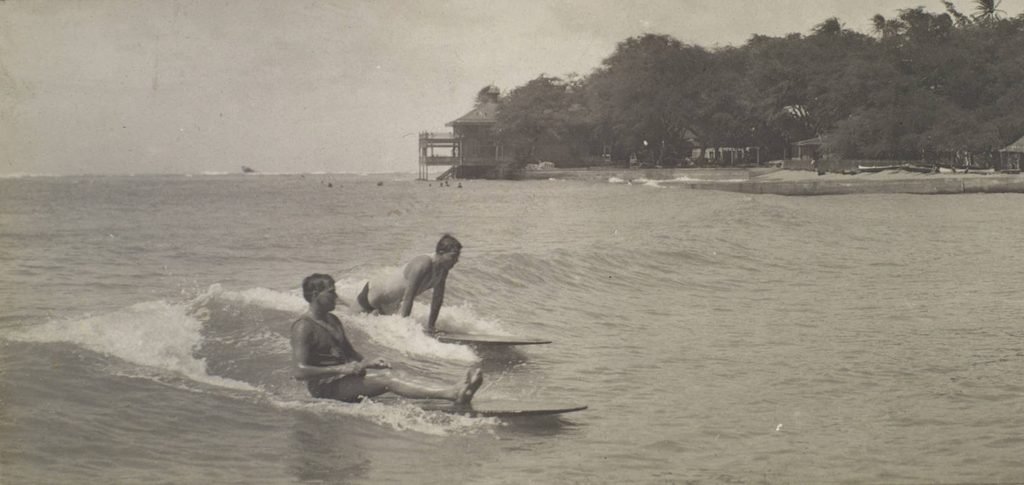
Moser suggests that, “rather than a lost art, surfing merely needed the right circumstances and the right person, to elevate its appeal and potential.”
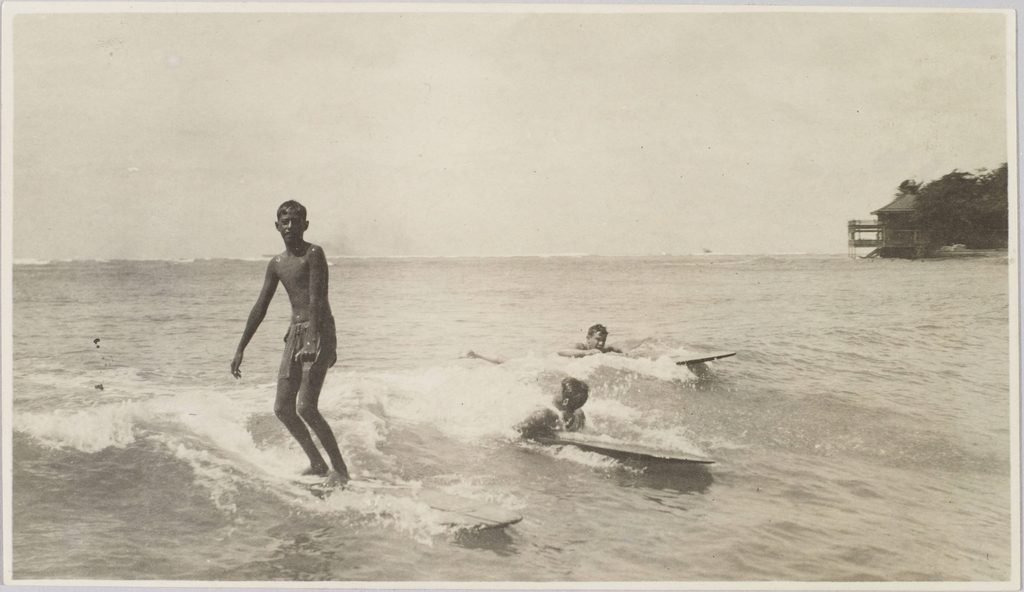
That person was George Freeth. The young swimmer’s first attempts at surfing were on an olo, a massive 16-foot-long surfboard that was heavy (this style of board can weigh more than 200 pounds) and cumbersome. He ended up shaping his own board based on another traditional Hawaiian shape, the alaia. This board was half the length and much lighter. Traditional boards had no kegs or fins. Steering was limited and could only be accomplished by using one’s feet.
Moser describes how Freeth started out by surfing prone and gradually worked his way up to standing.
“The native boys laughed at me when I made my first efforts,” Freeth wrote in a feature for the Evening Herald. “Now they hail me as a reviver of a lost art.”
Shortly before he set off for California in 1907, Freeth showed American author and adventurer Jack London how to surf standing up. London was unsuccessfully trying to keep hold of his board with the help of another of Freeth’s students, a recent arrival from the mainland named Alexander Hume Ford, when Freeth flew by on his board. Here’s London’s description:
“Out there in the midst of such a succession of big smoky [waves], a third man was added to our party, one Freeth. Shaking the water from my eyes as I emerged from one wave and peered ahead to see what the next one looked like, I saw him tearing in on the back of it, standing upright on his board, carelessly poised, a young god bronzed with sunburn”.
Freeth circled back and spent the rest of the day helping London learn to surf. Ford would go on to become a passionate proponent of surfing (and would take credit for reviving the tradition). On that day he, like London, was just a beginner.
London’s essay, later published as a chapter in London’s book about hisSouth Sea adventures, The Cruise of the Snark, did a lot to popularize—and romanticize—surfing.
Powerful and calm are perfect words for Freeth, but he was also restless and adventurous. A few months later, he left Hawai‘i again.
“Freeth was restless by nature, but he was also forced to move around to earn a living,” writes Freeth biographer Patrick Moser. “…[his] hard luck turned out to be a boon for California beach culture. His life as a keiki auwana (literally, ‘wandering child’) turned him into a Johnny Appleseed of sorts, spreading surfing and lifeguarding from Los Angeles to San Diego.”
Moser writes that Freeth, 23, was in search of adventure when he headed back to California in 1907. This time, he ended up being drawn to Venice Beach.
Abbott Kinney, who developed Venice and built the pleasure pier there, needed lifeguards. A series of drownings off the beach and pier was bad for business, and as more and more people were drawn to the beach, there was more risk of accidents. The summer surf in Venice wasn’t great the year Freeth arrived, and the surfing demonstrations that he planned were often cancelled, but Freeth’s work as a lifeguard was a tremendous success. He was soon training other lifeguards. His students learned ocean swimming and rowing skills, how to handle a dory, how to dive under waves, and understand ocean conditions.
In 1908, when a group of fishermen from the Japanese fishing village just east of Topanga were swept into danger off of Venice by a sudden squall, Freeth leaped into the big surf over and over again, pulling seven men to safety. The lifeguards he trained saved four more. One of the techniques he introduced was swimming out and bringing the victim back into shore, instead of trying to throw them a rope or life preserver. That may seem basic, but it was a major innovation.
Freeth received a Congressional Medal for his rescue of the fishermen, and the undying gratitude of the fishing families—they pooled their resources and presented him with all the cash they could collect and a gold watch as a thank you gift.
Freeth never seems to have stayed anywhere for long. He soon moved on to Redondo Beach, another new beach community that was rapidly growing and needed lifeguards. The surf was better at Redondo, and Freeth gave surfing demonstrations advertised as “The Man Who Walks on Water,” and “The “Hawaiian Wonder.”
Wherever he went, Freeth shared his enthusiasm for swimming and the art of wave riding. He continued to pioneer and teach life saving techniques that are still used by lifeguards all over the world to make sure would-be surfers and other swimmers were safe in the water. Freeth also taught swimming and diving skills as well as surfing, and unlike most instructors, he coached women as well as men. He was a firm believer that one didn’t have to be a man to be a good waterman.
Freeth brought not only the Hawaiian art of surfing to California, he brought a little Hawaiian culture and philosophy to beach towns that had been modeled on English and East Coast seaside resorts and didn’t yet have their own cultural identity.
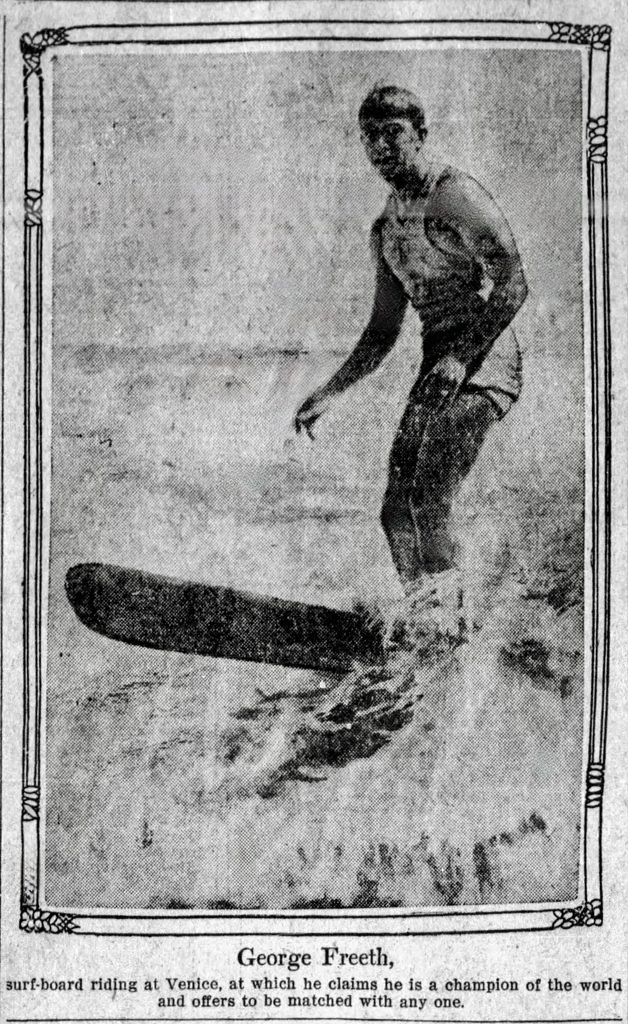
In 1912, Freeth was joined in Redondo by Hawaiian championship swimmer Duke Kahanamoku, who had been training for the 1912 Summer Olympics in Stockholm, Sweden, where he would win a gold medal in the 100-meter freestyle, and a silver team medal in the men’s 4×200-meter freestyle relay.
The two men were friends as well as colleagues. They corresponded for the rest of Freeth’s short life. In the wake of his success from his first Olympics, Kahanamoku traveled around the world, demonstrating swimming and surfing. He was an instant sensation not only in California, but also in Atlantic City, New Jersey, and Long Island, New York. Like Freeth, he taught swimming and surfing, and he also coached women as well as men.
The revival of surfing and the development of California’s unique surf and beach culture owe a lot to these two Hawaiians. Duke Kahanamoku is a familiar name to anyone in the surf scene. He had a long and adventurous life, promoting surfing, starring in silent movies, and even serving as Honolulu’s sheriff for many years.
Freeth is mostly forgotten, but he lives on in the lifesaving work he pioneered. Tens of thousands of people have been successfully pulled from the water alive thanks to this man’s dedication, and without him, surfing as we know it might never have taken off. That would have been a terrible loss not only for Hawaii, but for California, and the world.
What does any of this have to do with Topanga? Everyone of the surfers out on the Topanga surfbreak, every lifeguard who has ever worked the Topanga tower, every person who has ever been pulled from the water there, every child who is taught ocean swimming and ocean awareness has a connection to George Freeth. He was an unassuming real life superhero, whose actions continue to touch the lives of others.
Patrick Moser’s 2022 biography, Surf and Rescue, George Freeth and the Birth of California Beach Culture, is an engaging and interesting read.