





“Every morning, I read the Bible and the New York Times, so I can see what each side is up to.”
—Cal Thomas, Christian conservative syndicated columnist and author*
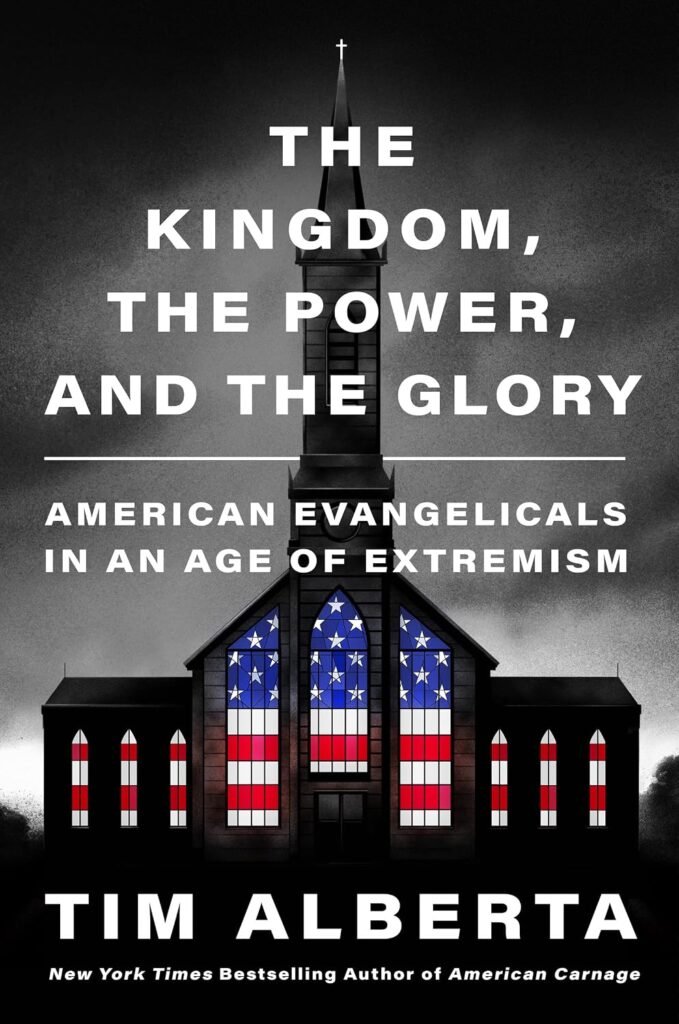
In The Kingdom, The Power, and The Glory: American Evangelicals in an Age of Extremism (2023), renowned journalist and historian Tim Alberta writes that evangelical Christianity is in peril.
Alberta is a journalist and historian, and he brings those skills to the project. For this one, however, Alberta draws heavily upon his personal experiences as an evangelical Christian. He was raised within a church community overseen by his father who was, during the author’s childhood, pastor of Cornerstone Evangelical Presbyterian Church in Brighton, Michigan.
The driving force of this enlightening book is Alberta’s years-long effort to understand the near-existential politically-charged forces that have come to bear upon his fellow evangelical Christians; and the great number of those identifying themselves as evangelical whose overt behaviors dramatically and unapologetically defy the teachings of Jesus as clearly expressed in the New Testament.
This is an extremely personal story which begins with Alberta’s father Richard, who once described himself as a “devout atheist,” becoming an evangelical at age 30. By the time Tim Alberta was born, his father had established the Cornerstone Church, which he led for 25 years. His mother also worked at Cornerstone so the church became Tim Alberta’s home.
While serving a white conservative community who voted heavily Republican, politics played only a minor role in Cornerstone’s commitment to the gospel. “Throughout my childhood,” Alberta writes, “Dad always talked about politics through the lens of ethics. He believed that integrity was a prerequisite for political leadership.” He had particular disdain for Bill Clinton and his improprieties and the family celebrated the election of George W. Bush in 2000.
Then things changed. A member of the Cornerstone Church was killed in Iraq and Pastor Alberta became incensed at those protesting the war. The problem for his son was that his father expressed this anger from the pulpit during the marine’s memorial service: “I am ashamed, personally,” his dad preached, “of leaders who say they support the troops but not the commander-in-chief… Do they not see that discourages the warriors and encourages the terrorists?”
For Tim Alberta, the question was: How does criticizing anti-war protesters fulfill the evangelical aspiration to live as Jesus Christ did as testified to in the New Testament?
“It touched off a firestorm in our community,” Alberta writes. “Most of the church members were all for Dad’s remarks, but even in a conservative town like Brighton, plenty of people felt uneasy about turning a fallen Marine’s church memorial into a partisan political rally.”
When Barack Obama was elected in 2008, the politicization of Cornerstone began to adopt the more broadly growing politicization of evangelicalism as a whole. The white evangelical community so openly resisted Obama that Pastor Alberta felt comfortable, in 2010, showing an anti-Obamacare video during a church service.
Tim told his father that he felt this to be inappropriate and the ensuing discussions marked, in a polite manner, the divide between father and son that represented the larger divide, not-so-polite, that has now subsumed evangelical churches across the nation.
The events of Pastor Alberta’s retirement serve as a microcosm of this cultural phenomenon. In 2013, he chose a young associate pastor named Chris Winans to prepare him to eventually lead Cornerstone; which he did in 2018. While it became clear to the flock that Pastor Chris was not as conservative as they may have liked, Pastor Alberta was still there to support him. However, Pastor Alberta died in 2019, COVID struck in 2020, and Michigan Governor Gretchen Whitmer ordered the closing of in-person church services.
Pastor Winans supported the COVID shutdown while many in his flock treated this as the long-awaited frontal assault on Christianity in America. They began fleeing the church in droves. But where were these children of God to go? As it happens, there was another church just down the street which welcomed anyone who shared Pastor Bill Bolin’s most rabid and conspiratorial views about secular America’s devious plan to undermine, and even outlaw, Christianity in the country.
Sermons at this church, appropriately named Floodgate, were replete with conservative political commentary that would make the most hard core MAGA supporter proud. So, how did Bolin arrive at this particular formula for modern evangelical success?
Alberta quotes a distressed Pastor Winans, “if you tell them what they don’t want to hear, they’re gone. They’ll find another church. They’ll find another pastor who tells them what they want to hear.” Winans was correct. Floodgate can now be described as a “megachurch.”
Rewind the clock about a half-century; which Tim Alberta does with historical flair and also, in this particular setting, with biblical grace.
You may recall that the Moral Majority of the 1970s and 1980s was also known as the “silent majority”; millions of largely apolitical Christians who might organize into a political force that had the potential to overwhelm the American political structure. The result of these efforts so many years later is the advent of President Donald Trump.
Tim Alberta writes that the idea of an upper case “Evangelical Church” can be attributed to this movement; the organizing of many different denominations into a near-single-minded entity. Unfortunately, the more the “Church” engaged politically with society, the more it became threatened, especially as the numbers of Americans going to church and describing themselves as Christians was in stark decline.
Characters such as Jerry Falwell and his son Jerry, Jr. oversaw the creation of Liberty University in the 1970s and 1980s. Ralph Reed of the Faith and Freedom Coalition organized churches across the country in the 1990s giving force to a Republican takeover of Congress in the 1990s. More recently, Paula White, a televangelist and eventual spiritual adviser to Donald Trump, is also featured. Charlie Kirk and his Turning Point USA are referenced here, as well, eerily reminding the reader that this book was published before his assassination.
Alberta engages with these personalities and many more to demonstrate the transformation of the Evangelical Church into a political force that is dominating today’s political landscape. Yet, his approach is not as confrontational as it might be. Alberta does not so much harp on the manner in which the politicization of the church has affected America’s electoral politics. His concern, rather, is more with the effect this transformation is having upon this church itself.
The result is that Alberta’s personal and spiritually driven approach has some of the most vocal Christian nationalists recognizing that what they are doing does not sit right with the teachings of Jesus; even though they are quick to justify their actions by cherry-picking references from the Bible. Unfortunately many of these references derive from the Old Testament and do not line up with the message Jesus and his apostles delivered.
Alberta writes that very word “evangelical” means to reach out and embrace those who are not yet part of the Church. This is exactly the opposite of the tactics many of the militant Christian nationalist leaders have adopted; rather than welcoming non-believers, they are rejecting them. And further, even the faithful who dare claim some liberal tendencies have been excluded. This is what happened to Pastor Chris Winans at Cornerstone. Although, I was pleased to discover that he has weathered the storm and continues to lead the church left to him by Tim Alberta’s father.
Instead of preaching the gospel as found in the New Testament, many evangelical pastors across the country are meeting to hear a unified message from people like Ralph Reed. In a gathering of his Faith and Freedom coalition, during the run-up to the 2022 mid-term elections, Reed bragged that the organization had “40 million people in its voter file.”
Alberta witnessed first-hand what had been happening to his church. “For three days,” Alberta writes of the message delivered to those Christian voters, “Reed looked on as thousands of believers were being told that their children were being groomed; that their communities were under invasion; that their guns were going to be confiscated; that their medical treatments were suspect; that their newspapers were lying to them; that their elected officials were diabolical; that their government was coming after them; that their faith was being banned from public life; that their leader [Trump] was being unjustly persecuted on their behalf; that their nation was nearing its end.”
Alberta describes the good old days, “when American evangelicals squabbled over things like socialized medicine. At present the Church was imploding over the legitimacy of our election system; the question of whether to confront racism in society; the etiquette of wearing masks during a lethal pandemic; the morality of vaccines; and the existence of a satanic cult of Democrats who cannibalize kids.”
Pastor Bolin at Floodgate, which had won over many of Cornerstone’s flock, gave a typical Sunday sermon in October of 2021.Alberta observed, “the pastor riffed on everything from California forcing vaccines on schoolchildren to the IRS proposing more oversight of personal banking accounts. He promoted a new book that warned of a ‘war on Christianity’ in America that will strip believers of their right to worship God (prompting the couple in front of me to make a one-click Amazon purchase). He shared that, after a recent conversation with a Fox News commentator, he could no longer rule out a second civil war. He suggested that there was mounting evidence that the presidency was stolen from Donald Trump in 2020… The churchgoers around me cheered.” Amen?
Alberta laments, “Rather than being challenged and transformed by the gospel, they were now coming to church to have their worst impulses confirmed.”
As in so many things in American life, money and power are driving the divisions in the Evangelical Church. When asked why fundraising letters were so filled with hate and ugliness, Alberta quotes one Christian fundraiser saying, “You can’t raise money on a positive. If the goal is bringing in money, you have to scare them.”
Alberta describes another preacher, Greg Locke from Mt. Juliet, Tennessee, who understood how to raise money. “He discovered that there was a market for being irrational,” Alberta writes. “He came to appreciate that wrath is a business model, that crazy is a church growth strategy, that hating enemies is far more powerful—at least in the immediate sense—than loving them.”
Not all evangelical church leaders succumbed to the temptation of power and money. One pastor who sees things as Alberta does says, “The harder thing to do is what I’m doing… This is how you lose people [by refusing to bastardize the gospel]. How you gain people [as other pastors were doing successfully] is, you pick a tribe, raise the flag, and be really loud about it. That’s how you gain a bunch of numbers. That is easy to do. And it cheapens the gospel.”
Father and son duo Doug and Nick Olson, share extensively their experiences with the politicization of Liberty University. Nick Olsen tells Alberta, “I don’t see a lot of humility in the way that Christians relate to the world around us. And that’s strange. Because the best teacher is the one who modeled humility. The best teacher is the one who said, ‘Knock and the door will be opened to you.’”
An employee at Liberty, Dr. Aaron Werner, spoke up about the corruption at the school and was fired. He was then offered “nearly $25,000 in exchange for remaining silent about the university.” When speaking with Alberta, Werner made a joke that perfectly captures Alberta’s thesis. A strict code of conduct governed the culture at Liberty: a dress code, military style haircuts, and of course, no alcohol. Werner quipped, “You couldn’t have a glass of wine. You couldn’t have long hair. You couldn’t even wear sandals.” He told one professor, “You guys would kick Jesus out of this place.”
Alberta also interviews Julie Roys who lost her job at the Moody Bible Institute for daring to say, as she explains to Alberta, “I think God wants us to be tending to the people who have been strewn along the side of the road. There are so many of them, so many casualties of this corruption in the Church. But I’ll tell you, these people, they’re some of the strongest Christians I’ve ever known. Because they’ve held on to their beliefs despite having every reason not to.”
Roys sees the power of money, too. “This evangelical-industrial complex—making millions, getting famous, building some ‘brand,’ restoring wolves to prey on more sheep—has absolutely nothing to do with Jesus. And we’ve got to stop pretending it does.”
Pastor Brian Zahnd of World Life Church in Missouri, an evangelical leader and author, refused to engage in Christian nationalist practices within his church. Alberta quotes Zahnd, saying, “You are forming your people in anger and hate. You are helping intensify their capacity to hate other people. You are giving them permission to carry around this permanent rage.” Zahnd summarizes the problem: “The idea that Jesus is some mascot for the donkeys or elephants—it’s a catastrophe for the gospel.”
Russell Moore, the former president of the Southern Baptist Convention, resigned under a Christian nationalist cloud that had gathered over the church but saw the way forward. “A good place to start is for Christians to worry less about perceived enemies and more about supposed allies,” Moore said.
Alberta adds, “I knew just what he meant: Today’s evangelicalism preaches bitterness toward unbelievers and bottomless grace for churchgoing Christians, yet the New Testament model is exactly the opposite, stressing strict accountability for those inside the Church and abounding charity to those outside it.”
Tens of millions of white Christian nationalists, with their voices and their votes, shun and shame refugees; separate families at the border; withdraw support for the hungry and the poor at home and abroad; support harsh punishments for non-violent offenders; condone the wrongful execution of the innocent; deprive their neighbors of access to health care; deny women control of their own bodies while celebrating a Dobbs decision that has actually resulted in more abortions, and support laws that contribute to the number one cause of death among young people…gun violence.
Thankfully, there are many sane Christians who have borne witness to the tragic politicization and potential militarization of the Evangelical Church; and Tim Alberta’s The Kingdom, The Power, and The Glory is sound and biblically-inspired testament to that.**
**58 Minute Interview of Tim Alberta
https://www.c-span.org/program/book-tv/after-words-with-tim-alberta/635266