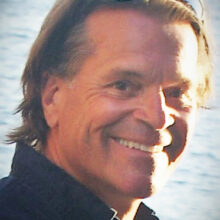
In his introductory Author’s Note David Baerwald pronounces that “The Fire Agent is a work of fiction. All incidents and dialogue, and all of the characters, with the exception of some well-known historical figures, are the products of the author’s imagination and are not to be construed as real.”
The central character in The Fire Agent (2026) is Ernst Baerwald, the author’s grandfather; and many of the fascinating events depicted in this intriguing “fictional” story hold up rather well under internet scrutiny; including the very real biography of Ernst.
On the cover, reviewer Graham Yost writes, “A Spy Novel, a war story, a love story… A brilliant piece of historical fiction that is hardly fiction at all.”
Set during the first half of the twentieth century primarily in Germany, Italy, and Japan, the reader gets a clear sense of how it came to be that these three nations formed the Axis Powers during World War II. An aristocratic German-Jew, Ernst graduates from an elite school as a linguist and musician whose gift of learning new languages puts him at the center of the intrigue in Europe and Asia. Sent to Italy by a chemical company that would later become part of IG Farben, and in collaboration with a collection of industrialists and politicians known as the Frankfurt Group, Ernst is trained in the art of industrial espionage by a Japanese sensei who guides the pupil early on with the message: “How may I serve with honor if my masters have none.”
This mantra will be tested often as Farben becomes the producer of poisons that would be used to murder Jews during the Holocaust. If this sounds a bit contradictory, you are beginning to not only prepare yourself to follow this fascinating book, but also to get a sense of what it must have been like to live during the most violent half-century in human history. And this is the great beauty of Baerwald’s historical “fiction,” a record that both educates and entertains.
The great irony explored within The Fire Agent is that those participating in and applying the technological and scientific achievements of the nineteenth century were young idealists like Ernst. “Most of the scientists of the companies that made up the Frankfurt Group,” Baerwald writes “were Jews, progressive enlightenment Jews to boot, and most agreed: Chemistry should be a life-giver. It almost went without saying. Food, medicines, color. Cures for deadly disease. Things to improve life. It was impossible to list all the wonderful things German science had already done, how many lives had been saved.”
In the case of Ernst’s chemical work, the Industrial Revolution of the nineteenth century had given rise to a serious threat to humanity by the beginning of the twentieth. A German chemist named Fritz Haber identified the problem: “At the very same time our populations are exploding. All over the world, populations are doubling every forty years.” He adds that the “global supply of nitrates is nearing depletion. Without that, our farms die. They are dying now.”
He also solved the problem by developing a synthetic fertilizer, anhydrous ammonia, whose raw materials were literally in the air; hydrogen and nitrogen. “‘It is proven,’ he said. ‘We are now able to produce ammonium nitrate from nothing more than heat, air, pressure, and water. Bread from air, as they say. We will quadruple, octuple our capacity to grow food. Gentlemen, we will save the world.’”
While Haber would receive a Nobel Prize for his work, and the words above are from his acceptance speech, he is also remembered as the father of chemical warfare. The same science that would feed the world would also contribute to its near destruction.*
When describing this chemical process in its early development to a group of potential investors, some of the attendees had other interests besides feeding the world.
Krupp, an armament company, was the industrial giant that provided the material means with which Germany waged two world wars. “For four and a half centuries,” Baerwald writes, “Krupp swords, bullets, and bombs had slaughtered Russians, Germans, Frenchmen, Congolese, Italians, Japanese, Chinese, and Dutchmen alike. Krupp warships prowled the seas under the flag of every country rich enough to buy them. When nations teetered on the abyss of peace, Krupp couriers were there, whispering, ‘War.’ When nations couldn’t afford to keep their wars going, Krupp bankers were there to whisper, ‘Credit at 8 percent compound interest.’”
(If you haven’t noticed, the United States has played a very similar role in arming the planet for most of the last century.)
As Haber appealed to the investors in 1910 or so, “One of the Prussians from Krupp stood up. ‘Your process is also suitable for the manufacture of gunpowder. These tons you discuss—would that include demand for ammonium nitrate for gunpowder and explosives?’” As Baerwald adds, “the investors waved their checkbooks like flags.”
Further complicating the dizzying array of European alliances that developed on the eve of World War I, American corporate power—including John D. Rockefeller—was already heavily entangled within the war-making interests. “The Frankfurt Group,” Baerwald notes, “of German banking, chemical, and medical concerns had been cooperating closely for decades. But now with Rockefeller’s limitless resources and Krupp’s history with every royal house in Europe, a new, globe-straddling behemoth was born.”
Part of that behemoth was Ernst Baerwald, stationed in Tokyo beginning in 1910, where he served as a trade representative for the company that would become Farben. When war broke out in Europe in 1914, Japan honored its 1902 treaty with Great Britain – which had been signed to protect their common interests in East Asia – and found itself at war with Germany. Ernst was compelled to defend a German naval base at Tsingtao. Thinking like many that the war would end quickly, Ernst had only a bit of trepidation in fighting a war against a people he had begun to deeply admire.
On the way to the German base in September of 1914, David Baerwald has his grandfather coming across this newspaper headline from Europe:
FIGHTING ON MARNE RIVER
2 MILLION CLASH, 60,000 DEAD IN FOUR HOURS OF FIGHTING
DEATH ON AN INDUSTRIAL SCALE
MACHINE GUNS MOW DOWN THE HUN
Ernst realizes that those machine guns are German-made and that he is the Hun.
What transpired next actually lays the groundwork for a future German-Japan alliance and I’ll say only that it has a great deal to do with the creation of a massive prisoner of war camp orchestra and choir. (Do as I did to confirm this one as bona-fide history and Google “Bando Chamber Orchestra.”) While Ernst spends the war in an amazingly comfortable POW camp, Europe explodes.
One of the most horrifying realities of World War I is also provided by German chemists. Before using chlorine gas against the entrenched allies on Germany’s Western Front at the Battle of Ypres in 1915, the chemists tested the weapons on pigs. I’ve italicized Baerwald’s description of this event for those of you who have not yet had lunch.
“The gas-filled flak exploded as promised, and the air above the pigs filled with a pus-yellow substance that joined in an oily mass into one single form, ten fingers of it, sinking to earth like the implacable hands of a strangler.”
“The corpses of birds—jays, sparrows, crows—fell to earth from the sky as the cloud sank behind them. The pigs looked up as one at the unfamiliar sight before the daggers of pain stabbed and slashed their way into their bloodstreams. They screamed like men, thrashing on the ground, pulling against their chains. Bile and phlegm drowned them, they bled from every orifice, and they died. The three general assistants, usually so chatty, for once had nothing to say.”
I’ll also spare you Baerwald’s description of the Battle of Ypres where chlorine gas was first used as a large-scale weapon of war; only to say that 5000 canisters containing over 150 tons of chlorine gas were exploded above a four mile long series of trenches containing thousands of Frenchmen and Moroccans. Being heavier than air, the gas fell down into the trenches and the human beings climbed out. This all occurred as the industrialists, nobility, and politicians looked on with their binoculars; cheering the success of their new weapon (I found it interesting that this first major use of chlorine gas occurred on April 22, 1915; or Earth Day before Earth Day was Earth Day).
Of course, the egregiously misnamed War to End All Wars was followed by World War II which carried its own brand of horror. Again, it is often forgotten that, while atomic weapons ended the war in ghastly fashion, chemicals played a role throughout. This is Baerwald’s description from early 1945: “Tonight four hundred American bombers would pour tons of jellied gasoline and high explosives onto the kindling-wood homes of Tokyo, and the fire dragons would walk again.” One participant in the conflagration says, “We’ll never get the blood off our hands… Not in a thousand years.”
As the firebombing spread, Baerwald adds that, “the US Army Air Corps had kept it up, firebombing sixty-two more Japanese cities until the targeting teams in Saipan were forced to confess that there was nothing left to bomb. Which hadn’t stopped Fat Man and Little Boy. The A-bombs fell in August.”
There is so much more to The Fire Agent than this type of gore although, given our current circumstances, including the very real threat posed by Artificial Intelligence, it can’t hurt to remind ourselves that the promises of technological wonder from corporations driven by a lust for profit are often fulfilled at the expense of those present at their unfolding.
Just as a handful of witnesses like Ernst Baerwald eventually stood fast against the technological madness in the first half of the twentieth century, a handful of those who understand the dangers of AI are beginning to speak up; just the other day for example. Former Anthropic researcher Jacob Coxon resigned on September 8, 2026 and then issued this warning: “Do not underestimate the power of [AI] technology. These will soon be superhuman systems that can hack anything, revolutionize any field overnight, and acquire real power and resources… The people building AI earnestly believe that it could kill us all by the end of the decade.”**
Finally, and to end this one on a more positive note, this is from The Fire Agent’s cover jacket: “David Baerwald is an award-winning singer-songwriter, and recording artist, best known for his critically acclaimed hit album with David Ricketts, Boomtown.” Check here for an MTV-style video of “Welcome to Boomtown” with a classic 1980s rock vibe.***
*Fritz Haber Nobel Prize Acceptance Speech
https://www.nobelprize.org/uploads/2018/06/haber-lecture.pdf
**CNN’s Anderson Cooper interviews AI Researcher and Whistleblower Jacob Coxon
***”Welcome to the Boomtown” with David Baerwald and David Ricketts