



How two musicians and a community of volunteers brought an overlooked Woodland Hills landmark back to life.
So much history. So much potential. Yet there it sat, an empty stage in an 80-year-old building, its aging walls in desperate need of a coat of paint, and its floors covered in a musty, stained brown carpet.
The space called out to Gerrit Kinkel like an unfulfilled promise of something great. In his mind, he could already see his jazz band playing there. He could picture the dimly lit, cozy, and elegant room buzzing with cocktail-sipping guests dressed to the nines, while the brightly lit stage came alive against the dark curtain drapes, filling the room with vibrant sound.
For years, every time he was there on the campus of the Woodland Hills Community Church where his kids attended nursery school, Kinkel’s thoughts would wander to the hall and its possibilities. An accomplished musician with three Grammys under his belt, he grew up playing in a brass band in Austria, where music and community were deeply intertwined. He longed to recreate that sense of connection—a place where you might bump into your neighbors, hear great music and experience something special without the special-occasion price tag.
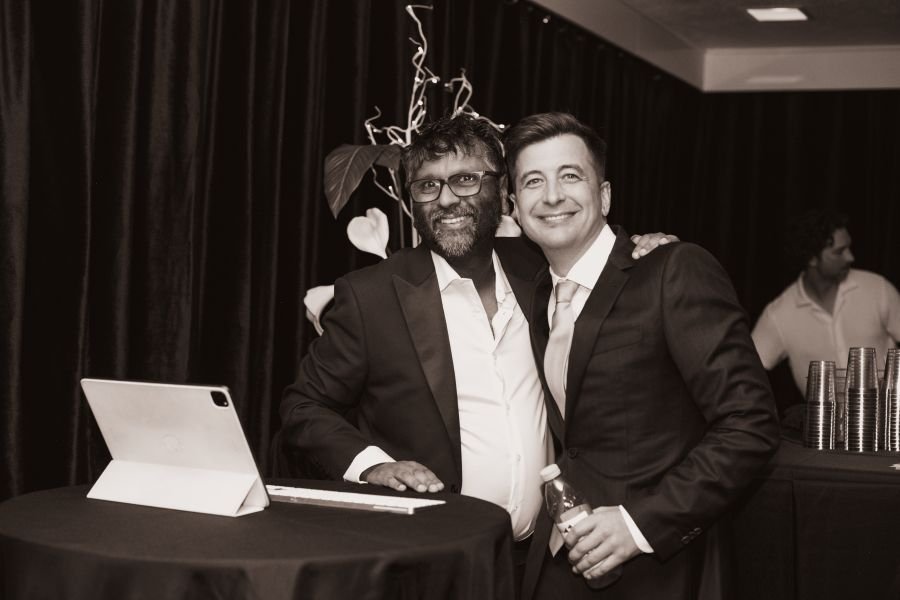
But it wasn’t until Kinkel met fellow musician Wayne Wilkins at a church event last year that all that imagining turned into action. Wilkins, a classically trained pianist, producer and composer of many hits including Natasha Bedingfield’s “These Words,” had been a member of the church for 15 years. He had been building musical programming there, including an open-mic night called Thursday Night Live. Kinkel first encountered Wilkins working behind the scenes at one of those events—setting up microphones, helping the performers, playing the piano to accompany their songs—and he recognized something familiar.
“He’s somebody like me!” he said. “I saw how hard he worked. He had that attitude, of going above and beyond. He was always trying to lift everything and everybody up.”
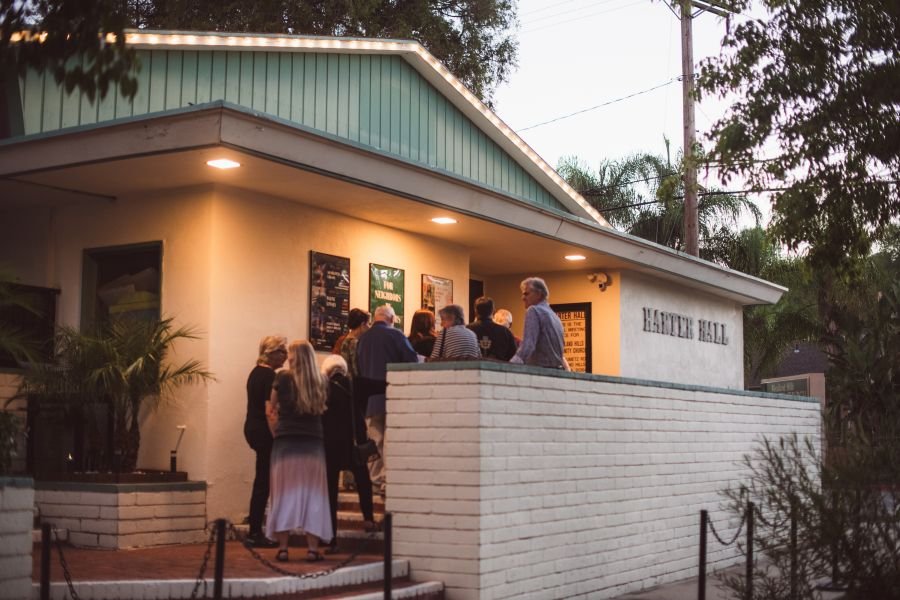
The two hit it off and bonded over their shared goal of turning that hall space into something great. Their idea quickly grew into a grassroots effort to transform the aging building called Harter Hall into an intimate, affordable home for live music, family programming and community events.
The transformation began with air conditioning, funded in part through a combination of grant money and a contribution from a church member. Then new flooring was installed, in part through proceeds from one of Wilkins’ concerts. Next came lighting, sound, curtains, new paint, new fixtures and a host of other improvements, funded by roughly $30K raised from a group of six community members, inspired by Kinkel and Wilkins’ vision.
There was no architect or interior designer. No sweeping demolition or rebuild. Instead, the project relied on the creativity, expertise and generosity of community volunteers who were willing to roll up their sleeves to make theW pair’s vision a reality. One person sourced new curtains that would line the stage and walls directly from a manufacturer, securing a deeply discounted rate. The curtains would give the room a cozy, intimate feel and also soundproof the space. Another volunteer figured out how to set up an entirely new stage-lighting system for less than $5,000. A community member with an engineering background designed custom brackets for the lights including the room’s signature five-foot chandelier.
Both Kinkel and Wilkins spent countless hours, scraping, sanding, painting and tinkering in the space to get it ready. One of their first projects became symbolic of the entire transformation: restoring the front door.
“We stood there looking at it and thinking, ‘What can we do with this door?’” Kinkel recalled. The large entrance door was painted a pale, washed-out green that did not fit the new aesthetic they envisioned for the hall. “And then we just said, ‘Okay, let’s just see what’s underneath.’”
So they started chipping away at the paint.
“Once you take the knife and you start chipping, you can’t go back. You just have to keep going,” Kinkel said. “And then it’s a question of, can you? I mean, do you have the muscle?”
Wayne recalls standing there with a heat gun against the door for two days, stripping layer after layer of paint.
“It was so hard, there were so many coats of paint! People would come up to us and say, ‘What have you guys just done?’” Wilkins recalled. “Because once we started, the door looked much worse than it did before. I think people were thinking, ‘These guys obviously don’t know what they’re doing.’”
But beneath all those layers, they discovered something worth saving: beautiful solid wood and striking brass brackets that had also been painted over.
“We just had to keep chipping and chipping away until that was restored,” Kinkel said. “And it takes time and it takes effort. And it takes multiple people going at it because, by yourself, you just think, ‘This is never ending.’”
That idea of finding the beauty underneath came to define their entire project. As they peeled back the layers, they began uncovering the history of the place itself.
Harter Hall has a rich history, deeply entwined with the development of the San Fernando Valley. In the 1940’s, Rev. Ellsworth Smith—who is said to have founded 101 Christian congregations during his pastoral career—started the effort to build a community center on four lots on the corner of Canoga Avenue and Dumetz Road.
The buildings that eventually took shape, including Harter Hall, are notable examples of mid-century modern design and represent an important chapter in the Valley’s post-war community development.
In the following decade, the campus became part of a community being reshaped by the rapid growth of the aerospace industry. Many of the families who lived in and around the area were connected to Rocketdyne, one of several manufacturers in the area serving the Defense Department and employing more than 1,000 people. The company would become best known for its work developing and testing the F-1 engine, which powered the Saturn V during the Apollo missions.
Rocketdyne’s presence helped drive an influx of families into the Valley in the 1950s. As industry expanded, the landscape changed with it – small residential lots and agricultural fields gave way to suburban neighborhoods, schools, churches, and commercial centers.
For more than 80 years, Harter Hall and the campus have served as a gathering place for the community. Boy Scout troops have met there. So has the Woodland Hills Chamber of Commerce. More than 15 recovery groups like Alcoholics Anonymous have used the space, along with the church’s nursery school. A local community theater company also uses the hall regularly.
And the site holds an even deeper space in Los Angeles history.
On January 15, 1961, Martin Luther King, Jr. gave two sermons at the Woodland Hills Community Church. He was invited by the Reverend Fred Doty to speak on racial equality, in what became one of King’s first visits to the Los Angeles area.
At the time, King’s visit was particularly significant. The surrounding community was overwhelmingly white, and discriminatory housing practices remained widespread.
More than six decades later, that history remains embedded in the walls of Harter Hall, a place that has spent generations serving as a gathering point for people, ideas and community.
“It’s about creating the environment for people to connect,” Kinkel said. “Like everything in life, the environment you’re in is everything.”
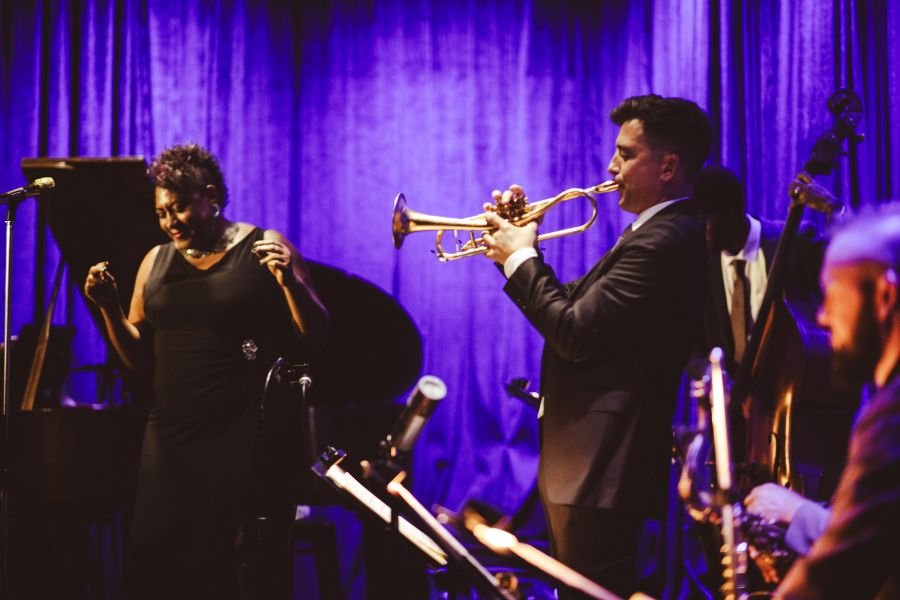
Finally, after months of hard work, on Saturday night, September 21, Kinkel and Wilkins stood on the stage of a transformed Harter Hall, welcoming guests to the first event following the renovation. The room had been reimagined as an intimate, cabaret-style venue. Guests in cocktail attire sipped craft cocktails at small round tables illuminated by tiny table lamps, all beneath the impressive chandelier. The dark curtains washed in green light gave the space the cozy, sophisticated vibe of a hidden speakeasy.
Then the music began. Kinkel took the stage with his Jazz Symposium band, playing the trumpet, alongside sax, flute, piano, bass and drums. Vocalist Sharlotte Gibson brought the room to life with a performance that celebrated two landmark jazz albums: Sarah Vaughan with Clifford Brown and Clifford Brown and Max Roach.
“Knowing Harter Hall as long as I have, it was amazing to see it transformed,” said Emily Sue, who volunteered to photograph the event with her business partner Sarah Vinson. Sue has attended countless events at Harter Hall over the past 12 years, both through the church and the nursery school that her kids attended.
During the three years she served as moderator of the church leadership—and continuing today as a member of the leadership team—she has advocated for making the church campus more accessible to the broader community.
“It was very well put together,” she said of the renovation. “Every detail was very intentional. It made the event feel very elevated.”
The community’s contribution to the transformation extended to her own family. Her husband, Todd, used his engineering skills to design and 3D print a mechanism that allows the curtains to be flipped—revealing either their black or white side.
“It was fantastic! Like being transported back to the 1950s in a speakeasy,” said Feisser Stone, founder of Barlingual, a full bar events and catering company, deeply connected to the Topanga community.
Stone, who knows Kinkel through their Topanga social circles, ran the bar that night. “I created the bar menu to have a feel of the Roaring ’20s, and to give it a little bit of a jazz sass too,” Stone said.
The concert was sold out – a fitting debut for a room that had been brought back to life not through major reconstruction, but through the vision, determination and collective effort of the people who believed there was something worth saving underneath.
Wilkins also plans to bring his own concert to the hall, although a date has not been set yet. Unlike Kinkel’s jazz performances, Wilkins is envisioning an experience that incorporates large screens projecting images throughout Harter Hall, creating a more immersive combination of live classical music and visual storytelling.
Now that the space can provide a reliable, quality and intimate setting for live performances, the pair is excited to draw on their network of artists and begin curating programming specifically for the community.
“From children’s programming, to art exhibitions, to immersive experiences… we really want to create value, and build trust among the community, so they know that when they come here, that they will see quality,” Kinkel said, explaining that Harter Hall will be home to much more than his jazz concerts. He’s especially excited about the upcoming family programming.
“Once a month the space will host a Family Series on Saturday mornings to provide kids and families highly curated musical experiences, meant to introduce young audiences to music through the lens of culture and storytelling,” he said.
The first family event, Flower Songs of Meso America, featuring Christopher Garcia & Family, introduced children to extraordinary Indigenous instruments through music, storytelling, and hands-on discovery.
Kinkel explained that internationally acclaimed multi-instrumentalist and educator Christopher García has spent more than three decades traveling the world, performing, composing and studying with master musicians across five continents. Alongside his wife and daughter, he will take families on a musical journey through the sounds, stories and traditions of the Indigenous peoples of North America and Mesoamerica.
“His passion is sharing the remarkable voices of traditional instruments—from carved wooden drums and ancient flutes to shell trumpets, rattles and instruments many children may never have seen or heard before,” he said.
At $20 per adult, with young children admitted free, Kinkel and Wilkins hope to build a regular audience of parents looking to give their kids a more elevated musical experience – one that comes in an equally special setting.
“We just want to bring people in, bring people together, through amazing music and art experiences,” Wilkins said. “This is about creating community.”
By Andrea Alegria
