




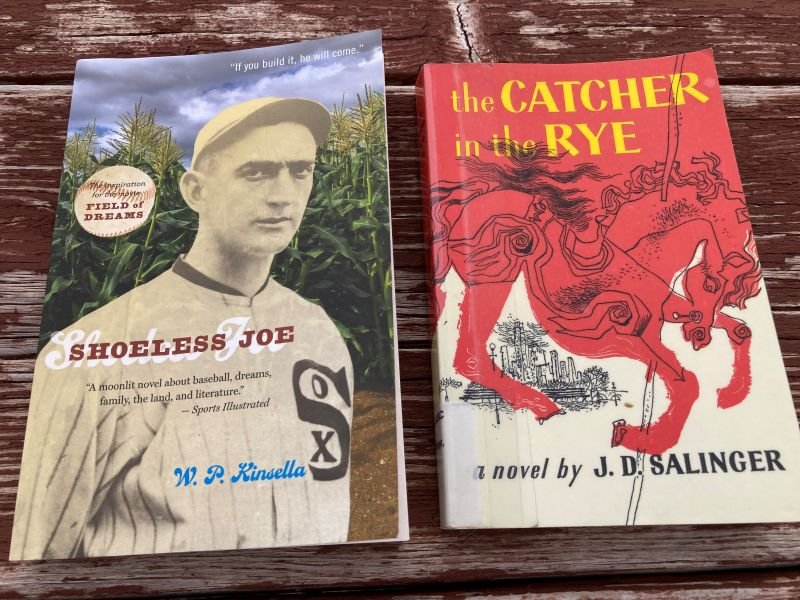
As one the most popular and relevant books from the twentieth century, The Catcher in the Rye’s most interesting characteristic is that the thoroughly authentic teenage angst expressed by its narrator, Holden Caulfield, has many adults continuing to scream that, three-quarters of a century on, they don’t want young people reading it. Of course, it is just this type of screaming that puts the book on a young man’s mind in the first place.
In more tolerant neighborhoods, The Catcher in the Rye (1951) has been an enduring staple of high school English courses and has made Holden Caulfield an iconic symbol of the teenage American male. As many teenage males will continue to attest, awakening to the realities of the human world into which we are born is often quite unpleasant. While most of the adults in Holden’s world are “phonies,” one old teacher helps set the young man straight. “Among other things,” the mentor tells Holden, “you’ll find that you’re not the first person who was confused and frightened and even sickened by human behavior.” All who have once been a teenage American male get that one.
As to really getting to know Holden Caulfield, I have a confession to make. Perhaps it was all that moving around in my youth that I somehow missed the class which showcased The Catcher in the Rye; my way of admitting that I only first read the book a week ago. And, to begin explaining the title of this piece, it was Shoeless Joe Jackson of the 1919 Chicago White Sox baseball team that finally got me there; with an assist from Kevin Costner.
Many of you are familiar with Field of Dreams (1989) starring Costner and James Earl Jones. Costner plays a reluctant Iowa farmer, Ray Kinsella, who is struggling to pay the farm’s mortgage. The corn in his field is tall, nearly time for harvest. One evening Ray hears a voice, “If you build it, he will come.” Then he hears it again. A few days later, Ray begins plowing down enough corn to construct a baseball field. The only person who believes that Ray is sane is his devoted wife Annie; and, of course, all of Kevin Costner’s many fans who know that, any magic in one of his films deserves the benefit of any doubt one may harbor.
Once the field is constructed, Shoeless Joe Jackson of the 1919 White Sox shows up with seven of his fellow ballplayers that were banned from the game after the 1919 World Series; accused of throwing the Series for a big payday from the real crooks. While the guilt or innocence of the eight ballplayers has been debated for more than a century, the eight guys in Kevin’s … that is, Ray’s… ballpark just wanna play ball (the deeper story of these ballplayers is told in Eight Men Out (1988) starring John Cusack and Charlie Sheen).
When Ray hears another voice, he’s off to New England to hook up with the reclusive and iconic 1960s counterculture writer Terence Mann (James Earl Jones), author of The Boat Rocker. They go to a Boston Red Sox game where other weird things happen. Then they end up in Minnesota where they hook up with none other than Moonlight Graham. Moonlight is another ballplayer from the early 1900s that lived in an age when they dished out really cool nicknames; and ballplayers were of a more humble variety, too.
One night in Minnesota, Ray and Moonlight visit a ballpark… under the moonlight of course… and Ray says, “A ballpark at night is more like a church than a church…” I can smell the dewy grass as I type…
Ray, Terence, and Moonlight then head back to Iowa so Ray can show his new friends that he really did build a ballpark in his cornfield.
Field of Dreams is one of those great movies that deserves re-watching once in a while, especially if you bring along one of the dozen or so people in the country who haven’t seen it. And, if you want to see things a bit more up close and personal, Major League Baseball has conducted an annual Field of Dreams baseball game since 2021, Iowa corn and all.
So, how does this strange path get me to Holden Caulfield? Well, after re-watching Field of Dreams recently—having been prompted by those unseen algorithms that seem to know me pretty well—I recalled that, among the many personal possessions my dad left me a few years ago, were a number of baseball books. Among them, I discovered Shoeless Joe (1982) by W.P. Kinsella. Hmmm? Kinsella? (If that’s not enough to pique your interest, a guy named Richard Kinsella pops up in The Catcher in the Rye.)
I still haven’t gotten to Holden yet, have I? Well, here it is. Remember the reclusive author Terence Mann played by James Earl Jones? It turns out that even though Field of Dreams has some real history baked into it, Terence Mann is a fictional character —The Boat Rocker is fake too—made up by Kevin and the other movie people who are familiar with these things.
When I read Shoeless Joe, upon which Field of Dreams was based, the reclusive author on the page is not Terence Mann, but rather, the very real J.D. Salinger whose Catcher in the Rye introduced generations of young men, and one old guy in Colorado to, you guessed it, Holden Caulfield.
As it turns out, J.D. Salinger, an iconic counterculture writer that helped birth the 1960s, and who appears to be just as reclusive as the fictional Terence Mann, got word that he was being portrayed in W.P. Kinsella’s Shoeless Joe. Not wanting to be misrepresented in print, J.D. called up his lawyers to check up on W.P. However, when J.D. discovered that W.P. had done a pretty decent job with J.D., he told his lawyers to back off.
When it came time to make the movie though, the producers were on alert for the potentially litigious J.D., so they created Terence Mann; one of the great characters in cinematic history played by James Earl Jones.
Don’t feel bad if you’re confused because I’m right there with ya… well, not really, because I’ve been pondering all this for the past ten days, especially in my effort to justify a Books & Such piece titled “Holden Caulfield and Shoeless Joe.” And now that you know the story, the title begins to ring a bit, don’t you think?
Even with all that explained so clearly, another mystery remains: How did Shoeless Joe lose his shoes? Like many historical trivia stories such as this, the answers vary, especially depending upon whether one thinks Joe is a crook or not for throwing the 1919 World Series. I don’t have an answer here for you on this point, but I will encourage you to ponder this observation from W.P. Kinsella’s Ray Kinsella as he sits in the bleachers of his Iowa ballpark: “And [Joe] sat down on the tender green grass of the outfield, untied his shoes and pulled them off, peeled off his socks and stuffed them in his shoes… Then he stood up and walked a few steps, and the look on his face would have inspired soldiers and poets and pinch hitters to perform as never before.”
That’s beautiful writing to a reader… and magical poetry to an old guy that used to hang out in left field waiting for the ball to come his way.